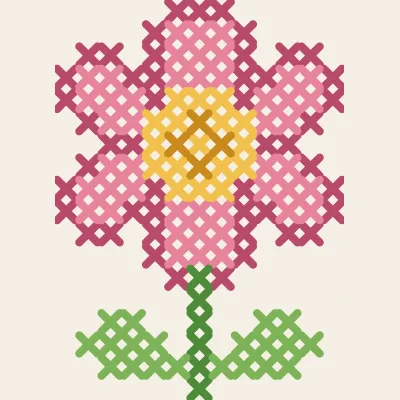
Garden Flower
A pink bloom on a stem with two leaves, 13×18 stitches.
Free pattern · beginner
A single leaf set on the diagonal, with a dark edge, a mid-green body and a pale vein running from stem to tip. Diagonal shapes are good practice for counting across rows.
Simulated preview, not a photo of stitched fabric.
| Symbol | Colour | Name | Stitches |
|---|---|---|---|
| Pine Green symbol | #2F6B3A | Pine Green ≈ DMC 561 Celadon Green VD | 31 |
| Fern Green symbol | #5E9E4A | Fern Green ≈ DMC 702 Kelly Green | 53 |
| Pale Green symbol | #9CCB6A | Pale Green ≈ DMC 471 Avocado Grn Very Light | 9 |
| Bark Brown symbol | #7A5230 | Bark Brown ≈ DMC 632 Desert Sand Ultra Very Dark | 2 |
| Total | 95 | ||
“≈ DMC” marks the nearest floss, not an exact match. How we match colours
Check these threads against my thread box: see which skeins you already have and download a shopping list for the rest.
| Fabric | Stitched area |
|---|---|
| 11-count Aida | 1.18 × 1.18 in (3.0 × 3.0 cm) |
| 14-count Aida | 0.93 × 0.93 in (2.4 × 2.4 cm) |
| 16-count Aida | 0.81 × 0.81 in (2.1 × 2.1 cm) |
| 18-count Aida | 0.72 × 0.72 in (1.8 × 1.8 cm) |
Where to start, how many strands to use and how much fabric to leave are the same for every design: see how to use our patterns.
A single leaf lies across the chart on the diagonal, from a short brown stem in the bottom left corner to a squared tip in the top right. The body is a solid fern green, edged in a darker pine green, and a pale green vein runs one stitch wide from stem to tip. Because everything is set at an angle, the design is good practice for counting stitches that move one square across with each row.
Stitch the pale vein first. It is a clean diagonal line of single stitches, and once it is in place the rest of the leaf is easy to position either side of it. Fill the fern green on both sides next, working along the rows. Add the pine green edge after that, then the two brown stitches of the stem. The vein stitches touch only at their corners, so pass the thread behind the fill between them rather than knotting each one.
It is just under an inch square on 14-count, small enough for a coaster centre, a card or an autumn table runner. Repeated along a row with each copy turned the other way, it makes a running border for the edge of a tablecloth.
For autumn colours, replace the greens with DMC 920 Copper Medium for the body, DMC 918 Red Copper Dark for the edge and DMC 3854 Autumn Gold Medium for the vein. A set of three, one green, one copper and one gold, makes a small seasonal display.
Because the leaf runs diagonally, each row starts one square further along than the row above, and slipping by one bends the whole leaf. The pale vein is your check: it should stay a single unbroken diagonal from stem to tip. If a gap or a double step appears in it, the row above has slipped.
Repeat it in rust, gold and deep red for a set of coasters or a table runner edge. The light vein needs a fabric darker than white to stand out clearly.
| Colour, most stitches first | Stitches | Separate areas | Groups of 1–2 stitches | Thread |
|---|---|---|---|---|
| Fern Green ≈ DMC 702 | 53 | 1 | 0 | 1.2 m |
| Pine Green ≈ DMC 561 | 31 | 13 | 10 | 0.7 m |
| Pale Green ≈ DMC 471 | 9 | 9 | 9 | 0.2 m |
| Bark Brown ≈ DMC 632 | 2 | 2 | 2 | 0.0 m |
Thread for 14-count Aida and 2 strands. How the plan is worked out
Stitched this design? Send us a photo and, with your permission, we will show it here with your name.
An original design, free under CC BY 4.0. What you can do with it
A pink bloom on a stem with two leaves, 13×18 stitches.
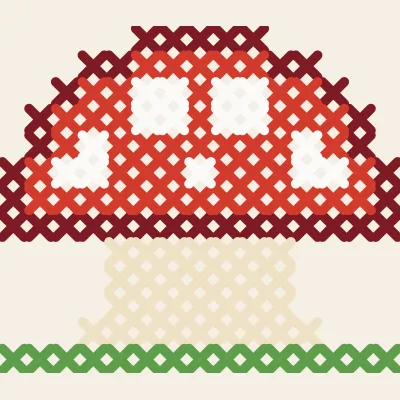
A red mushroom cap with white spots on a cream stem, 15×13.
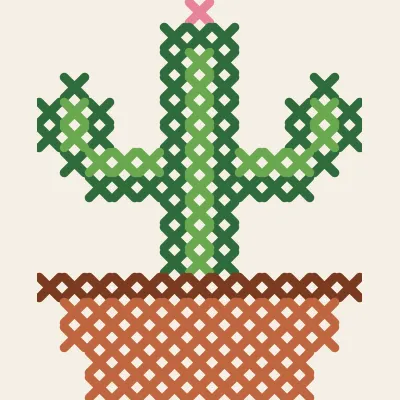
A flowering cactus in a terracotta pot, 13×16.