Guide
Beginner Cross Stitch Patterns: Choosing a Manageable Project
The short answer
A good beginner cross stitch pattern is small (under about 30 stitches on its longest side), uses five colours or fewer, contains only full cross stitches, has large solid areas instead of scattered single stitches, and is charted for 14-count Aida. A design you can finish in a few evenings teaches more than an ambitious one you abandon.
The most common reason people give up cross stitch isn’t difficulty. It’s choosing a first project that is far too big. A 200 × 200 landscape is 40,000 stitches; even at a brisk pace that’s many months before you see a finished piece. A small, well-chosen first pattern gets you to “finished” in a weekend, and that feeling is what makes the hobby stick.
Here is how to judge any pattern, ours or anyone else’s, before you start.
Criterion 1: Size
Look for designs under about 30 stitches on the longest side for a first project, and under 20 if you want to finish in an evening or two. At 14 stitches per inch, a 20-stitch motif is about 1.4 in (3.6 cm) across: perfect for a card, an ornament or a hoop.
To estimate time, count the stitches (our pattern pages list the exact total) and assume a beginner manages somewhere around 100–200 stitches an hour once warmed up; speeds vary a lot, so treat this only as a rough planning figure.
Criterion 2: Number of colours
Each colour is another thread change and another symbol to keep in mind. Five or fewer is ideal for a first piece. Three-colour designs like the Little Heart or Gold Star let you focus entirely on technique.
Criterion 3: Stitch types
Many patterns mix full crosses with half stitches, quarter stitches, backstitch outlines and French knots. Each is learnable, but not all at once. Choose a first chart that uses only full cross stitches. All the patterns in our library do.
Criterion 4: Solid areas versus confetti
Look at the chart. Do colours form solid blocks and clean outlines, or is it speckled with single squares of many colours? Confetti means starting and ending a thread for one or two stitches at a time, which is fiddly for experienced stitchers and discouraging for new ones. The Stitchability Check in the Studio counts isolated groups for any chart, and each of our pattern pages lists its number of isolated groups.
Criterion 5: Fabric
Patterns are usually stitched on 14-count Aida to begin with: the holes are easy to see, and two strands of floss give good coverage. 11-count is even easier on the eyes (use three strands). Save 18-count and linen for later.
Our beginner checklist
| Question | Good sign |
|---|---|
| How many stitches wide and tall? | Under ~30 × 30 |
| How many colours? | 5 or fewer |
| Which stitch types? | Full crosses only |
| Isolated single stitches? | Very few |
| Recommended fabric? | 14-count (or 11-count) Aida |
| Is there a clear key with symbols? | Yes, with stitch counts |
The beginner collection shows each pick with a note explaining exactly why it meets these criteria.
What else you need
A small starter kit covers almost any beginner pattern:
- 14-count Aida, cut at least 3 in (7–8 cm) larger than the design on every side
- six-strand embroidery floss in the pattern’s colours
- a blunt tapestry needle (size 24 is commonly used for 14-count)
- small sharp scissors
- an embroidery hoop a little larger than the design (optional but helpful)
- the printed chart, or the chart on a tablet in the tracker
The fabric, thread and needles guide explains each choice.
First-project workflow
- Print the chart and read the key (how).
- Fold the fabric to find its centre and start from the chart’s centre arrows.
- Use a loop start or waste knot rather than a knot (technique).
- Stitch the biggest area of one colour, then its neighbours.
- Mark progress as you go so you never lose your place.
Making a beginner version of anything
Love a design that’s too complex? You can simplify it:
- Fewer colours: in the Studio’s Check panel, use Reduce colours to merge similar shades; it lists every merge before applying.
- Less confetti: preview and apply the isolated-stitch cleanup.
- Smaller: convert the source again at a smaller width, or start with a name or short phrase instead.
Common mistakes
- Starting with a huge kit because it was on sale.
- Choosing pale colours on white fabric; contrast makes counting easier.
- Using too little fabric to fit a hoop.
- Skipping the key. Spend two minutes learning the symbols first.
Pick one design today, and aim to finish it this week. Your second project will be faster, neater and more ambitious, and that’s exactly how it should be.
Worked example: choosing between three patterns
Imagine you are deciding between three free patterns:
| Pattern | Size | Colours | Isolated groups | Verdict |
|---|---|---|---|---|
| Little Heart | 13 × 12 | 3 | very few | Ideal first project |
| Garden Flower | 13 × 18 | 6 | some (centre dots, leaf tips) | Good second project |
| A 150 × 150 photo portrait | 150 × 150 | 30+ | hundreds | Save for later |
The heart wins for a first piece: it uses less than a single skein per colour, can be finished in an evening or two, and teaches every basic skill (finding the centre, counting, starting and finishing threads).
Your first week
- Day 1: gather materials, read the chart, find the centre, stitch the first colour.
- Day 2: finish the outline and details; check the back is tidy.
- Day 3: finish the piece: hoop it, mount it on a card or back it with felt as an ornament.
- Next: pick a design with one more colour or a slightly larger size, such as the Gold Star or the Green Book.
Signs a pattern is too advanced for now
- More than about 10 colours, especially similar shades of one colour.
- Symbols that only differ slightly (two kinds of crosses or dots).
- Many fractional stitches or backstitch outlines.
- A finished size you cannot see yourself completing within a few weeks.
None of these make a pattern bad; they just make it a better second or third project. The Studio can simplify many patterns: merge similar colours, clean up isolated stitches, or stitch a cropped section first.
Your first hour, step by step
- Cut the fabric with at least 3 in (7.5 cm) spare on every side of the design. The size calculator gives the exact piece to cut for any chart.
- Find the centre by folding the fabric in half both ways and pinching the creases. The chart’s centre arrows mark the matching square.
- Separate two strands from an 18 in (45 cm) length of floss. Pull them out one at a time and put them back together; they lie flatter that way.
- Start with the largest block of one colour near the centre. Big areas teach you a steady rhythm before you meet single stitches.
- Work in rows of half stitches, then come back along the row to cross them. Keep every top leg leaning the same way.
- Mark what you’ve done on a printed chart or in the stitch tracker so you never count the same square twice.
A first-project shopping list
| Item | What to ask for | Why |
|---|---|---|
| Fabric | 14-count Aida, white or cream, a fat quarter | Easy-to-see holes, enough for several small projects |
| Thread | The DMC codes printed in your chart’s key | One skein per colour covers any small pattern |
| Needle | Tapestry needle, size 24 | Blunt tip slides between threads instead of splitting them |
| Hoop | 6 in (15 cm) plastic or wooden hoop | Keeps tension even; remove it between sessions |
| Scissors | Small sharp embroidery scissors | Clean cuts make threading easier |
Every pattern on this site lists the nearest DMC code for each colour and estimates skeins in the PDF key, so the list above is all you need to take to a shop.
Questions stitchers ask
What is the easiest cross stitch pattern to start with?
A small shape with three or four colours and solid areas, such as a heart or a star, under about 20 stitches on each side. It teaches technique without long counting.
Is 14-count Aida best for beginners?
It is the usual recommendation because the holes are easy to see and two strands give good coverage. 11-count is even easier on the eyes if you prefer larger stitches.
How many patterns should I buy or download at first?
One or two. Finishing a small piece quickly builds confidence; a stack of ambitious charts tends to stay unstitched.
Can I make a beginner version of a complex chart?
Often yes: reduce the colours, clean up isolated stitches and stitch only part of the design. The Studio shows exactly what each change does before you apply it.
Try it now
Everything in this guide works in the free cross stitch pattern maker, right in your browser, with no account.
See the beginner pattern collection →A pattern to practise with
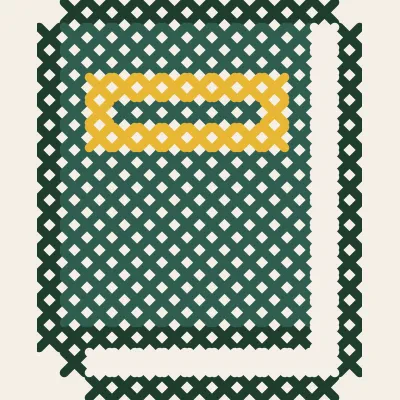
Green Book
A standing hardback with a gold title band, 13×16.