Guide
Choosing Fabric, Thread and Needles for Your Cross Stitch Chart
The short answer
For most charts, start with 14-count Aida, two strands of six-strand cotton floss and a size 24 tapestry needle. Use three strands on 11-count and one or two on 18-count or fine linen. Higher counts make smaller stitches. Always stitch a small test to check coverage, because thread brand, tension and fabric colour all change the result.
A chart tells you where to stitch; your materials decide how it looks. The same pattern can look bold and chunky or fine and delicate depending on fabric count and strands. Here’s how to choose, with the reasoning so you can adapt to whatever you have.
Fabric
Aida
Aida is woven in clear blocks with holes at each corner. Each block takes one cross stitch, which makes counting easy. It is the standard choice for beginners and for most charts (more on Aida). Common counts are 11, 14, 16 and 18 stitches per inch.
Evenweave and linen
These have single threads evenly spaced in both directions. Cross stitches are usually worked over two threads, so 28-count evenweave gives 14 stitches per inch. They drape more softly and look more refined, but counting threads takes practice. Linen has slight natural irregularity, which many stitchers love.
Fabric colour
White and cream are classic and make colours true. Pale blue, grey or coloured fabric can replace a background colour entirely: leave background squares empty and let the fabric do the work.
Thread
The most common thread is six-strand cotton embroidery floss. You cut a length (about 18 in / 45 cm is a common comfortable length) and separate it into individual strands, then recombine the number you need. This gives smoother coverage than using the strands twisted together.
Other threads, such as perle cotton, metallics, silks and variegated floss, have their own handling quirks; save them for later projects.
Matching strands to fabric
| Fabric | Strands for crosses | Common tapestry needle |
|---|---|---|
| 11-count Aida | 3 | 22 |
| 14-count Aida | 2 | 24 |
| 16-count Aida | 2 | 24–26 |
| 18-count Aida | 1–2 | 26 |
| 28-count evenweave over two | 2 | 26 |
| 32-count linen over two | 1–2 | 26–28 |
These are common starting points, consistent with guidance from embroidery organisations such as the Embroiderers’ Guild of America. Preferences vary: some stitchers use 3 strands on 14-count for fuller coverage.
Needles
Use tapestry needles: blunt tips that slip between fabric threads instead of piercing them, with a large eye for floss. Higher size numbers are finer. The needle should pass through the holes easily without stretching them.
Test for coverage
Before starting a big project, stitch a 10 × 10 square with your planned thread and strands. Look at it from a normal viewing distance:
- Fabric showing between stitches? Add a strand or stitch with slightly more relaxed tension.
- Stitches crowded and lumpy? Remove a strand.
- Colour different from expected? See screen colours versus floss.
Hoops and frames
A hoop or frame keeps fabric taut, giving even stitches. Choose a hoop slightly larger than the area you’re working on and move it as you go; for big pieces, scroll frames avoid crushing finished stitches. Take the fabric out of the hoop when you finish a session so it doesn’t leave marks.
How much fabric to buy
Stitched size plus margins on all sides. For a 100 × 100 design on 14-count: 7.1 in stitched + 2 × 3 in margins = about 13 × 13 in of fabric. The Studio’s Project panel calculates this for any count and margin, and every PDF prints it on the overview page.
About thread quantities
How much floss a design needs depends on the number of stitches, strands, fabric count, your tension and how much you waste starting and finishing. That’s why our charts list stitches per colour but don’t promise an exact number of skeins. For small designs one skein per colour is usually ample; for colours with thousands of stitches, buy extra and keep dye lots together.
Common mistakes
- Using a sharp embroidery needle on Aida, which splits the fabric threads.
- Using all six strands at once.
- Very long thread lengths that tangle and wear thin.
- Buying fabric for the stitched size without margins.
Once you know your combination, write it on the first page of your chart: fabric, count, strands and needle. Future you will be grateful.
Worked example: planning materials for a 100 × 100 design
- Fabric: on 14-count Aida the design is 7.1 × 7.1 inches. With 3-inch margins, buy at least 13.1 × 13.1 inches; a standard 14 × 18 inch pre-cut works.
- Thread: use the key’s stitch counts. Colours with only a few hundred stitches will usually need one skein; colours with several thousand may need more, so buy extra for those and keep dye lots together.
- Strands: two strands on 14-count; stitch a 10 × 10 test square to confirm coverage.
- Needle: tapestry size 24; keep a spare.
- Hoop or frame: a 6–8 inch hoop that you move around, or a scroll frame to avoid crushing finished stitches.
Fabric comparison
| Fabric | Ease of counting | Look | Typical use |
|---|---|---|---|
| Aida 11–14 | Easiest | Clear, structured grid | First projects, bold designs |
| Aida 16–18 | Moderate | Finer, smoother | Detailed charts, small keepsakes |
| Evenweave 28 over two | Moderate (count threads) | Soft drape, even | Samplers, intermediate projects |
| Linen 32+ over two | Harder (irregular threads) | Traditional, refined | Heirloom pieces |
Thread care
- Keep threads organised on cards labelled with their chart symbol.
- Separate strands one at a time and recombine for smoother coverage.
- Let the needle hang occasionally to untwist the thread.
- Store threads away from direct sunlight to prevent fading.
Estimating how much thread to buy
A full cross uses roughly 4.8 times the width of one square of thread per strand: two diagonals on the front and two short passes on the back. Add about a quarter for starting, ending and moving between stitches. In practice that means:
| Fabric | Strands | Full crosses per 8 m skein (approx.) |
|---|---|---|
| 11-count | 3 | about 1,100 |
| 14-count | 2 | about 2,200 |
| 16-count | 2 | about 2,500 |
| 18-count | 2 | about 2,800 |
| 28-count over two | 2 | about 2,200 |
These are planning figures, not guarantees: tension and how often you travel change real use. The Studio’s Threads tab and the PDF key apply the same method to your actual stitch counts per colour, and the size calculator gives a total for any design.
Buy extra for big areas. Dye lots vary slightly, so get all the skeins for a large background at the same time, plus one spare.
Matching thread to the chart
Every chart on this site lists the nearest DMC code for each colour; the DMC colour chart lets you browse all 489 colours and find the nearest thread for any colour you pick. Treat codes as a shortlist and compare real skeins in daylight.
Needle sizes at a glance
| Fabric | Tapestry needle |
|---|---|
| 11-count Aida | 22 |
| 14-count Aida | 24 |
| 16-count Aida | 24 or 26 |
| 18-count Aida, 28-count evenweave over two | 26 |
| 32-count linen and finer | 26 or 28 |
The needle should pass through a hole without pushing the fabric threads apart; if it drags, go up a size, and if it rattles loosely, go down one.
Questions stitchers ask
How many strands should I use on 14-count Aida?
Two strands of six-strand floss is the usual starting point. Some stitchers prefer three for fuller coverage; test a small square to decide.
What needle size goes with 14-count?
A blunt tapestry needle around size 24 is commonly used. Higher numbers are finer and suit higher fabric counts.
Can I use coloured fabric?
Yes. Coloured fabric can replace a background colour entirely. Check that your thread colours still contrast well against it.
How long should each thread length be?
About 18 inches (45 cm) is a common comfortable length; longer threads tangle and wear thin as you stitch.
Try it now
Everything in this guide works in the free cross stitch pattern maker, right in your browser, with no account.
Pick a pattern to stitch →A pattern to practise with
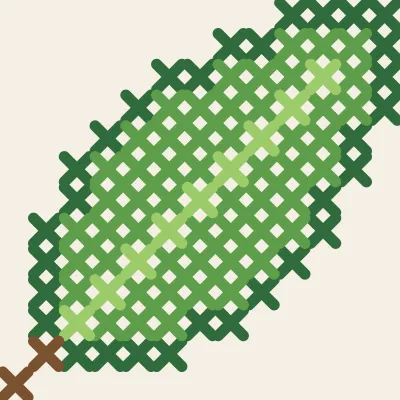
Autumn Leaf
A diagonal leaf with a light central vein, 13×13.